Case study · 2025 · AI · Workflow

When the trigger is the product: meeting-notes-to-IC-memo for a venture fund

Quorum is the automation we shipped for an India-based venture fund — pulling transcripts from four AI notetakers, mapping each conversation to a startup in the portfolio, and drafting structured due-diligence memos directly into the analyst's ClickUp workflow. The interesting part wasn't the model. It was the trigger — which we got wrong three times before we got it right.

  • ClientIndia-based venture fund
  • IndustryVenture Capital · AI Workflow
  • Year2025
  • EngagementProduction deployment · ongoing operation
Quorum AI workflow automation — meeting-notes-to-IC-memo pipeline triggered by ClickUp deal-stage changes.
01 — At a glance
Near 100%
Memo adoptionOnce the trigger was right. Previously near zero with cron.
4
Notetakers wiredFireflies, Read.ai, Fathom, Granola — adapter pattern handles all four.
42
Diligence questionsStructured per-stage section in every generated memo.
Summary

Quorum is a meeting-notes-to-IC-memo automation we built for an India-based venture fund. It pulls transcripts from four AI notetakers, maps each call to a startup in the portfolio, and drafts structured due-diligence memos directly into the analyst's ClickUp workflow. The engineering story is the trigger. We tried four — a cron job, contextual toggles, an explicit checkbox, and finally a ClickUp stage-change webhook with a ten-minute delay — before we landed on the one that produced near-100% adoption. The lesson generalized: in AI workflow tools, the trigger is the product. The model is the cheapest part.

The problem

Procurement was held together with Excel and goodwill.

Early-stage venture funds are not behind on AI. They're drowning in it. Every founder pitch is recorded by Fireflies. Every analyst call is captured by Read.ai. Every partner conversation lives in Fathom or Granola. The transcripts are accurate, searchable, and entirely orthogonal to the work the fund actually does, which is producing investment-committee memos that defend specific allocation decisions in front of partners on Fridays.

The brief, when we received it, was straightforward in the way a brief is straightforward right before it teaches you something. Take the transcripts. Run them through Claude. Produce a structured IC memo per startup, dropped into the right ClickUp doc, no human in the loop. The fund's analyst could stop spending Saturday afternoons writing memos by hand. We agreed in writing. We shipped it in three weeks.

The first version was correct. Nobody used it. 'Correct' is not 'usable' — the difference lived entirely in the trigger.

It worked the day we shipped it. Nobody used it. The transcripts were appearing in ClickUp on schedule. The memos were correct. The analyst was still writing memos by hand on Saturdays. The first version of this product taught us that 'correct' is not the same as 'usable' — and that the difference lived entirely in the trigger.

What followed was three rebuilds of the trigger and one durable observation: in AI workflow tools, the model is commoditized, the integrations are commoditized, the dashboard is commoditized, and the trigger — where it lives, what it watches, when it fires, how the user feels in relation to it — is the only thing left that compounds.

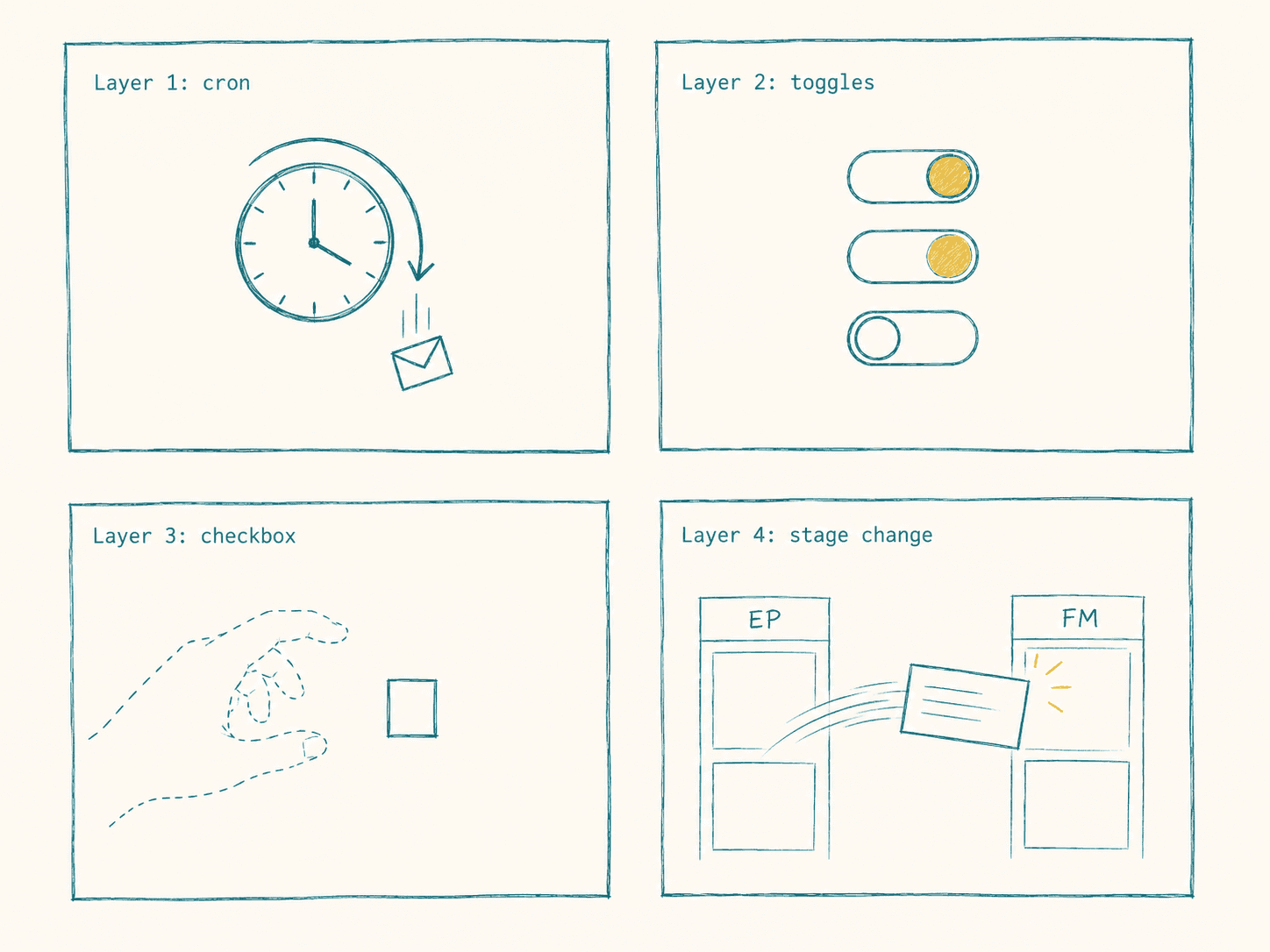
Four-panel sketch of the trigger evolution — cron clock, toggles, checkbox, kanban stage change — the fourth one highlighted as the one that worked.

Four trigger designs. Only the fourth produced adoption. The full story is in our published essay.

02 — Why us

Why they chose Synara

Three things weighed in our favor. First, we'd shipped AI workflow tools before and were comfortable in the messy middle — integrating multiple third-party notetaker APIs, structuring LLM output into typed schemas, and wiring everything into a tool the analyst already lived in (ClickUp). Second, we made the right call to focus on the trigger early; most agencies would have shipped the spec and moved on. Third, we were small enough that the analyst became part of the loop — we watched her work, asked her to draw the path of a single deal through her day, and rebuilt around what we saw.

The deeper alignment was on philosophy. We believe — and we said this in the proposal — that the LLM is the cheapest part of any AI-workflow product. The expensive parts are the integrations, the data shape, the trigger, and the way the user feels in relation to the system. The fund wanted a partner who agreed with this read of the field, not a partner who would let them buy a longer prompt.

03 — What we built

A three-portal procurement platform — buyer, supplier, admin.

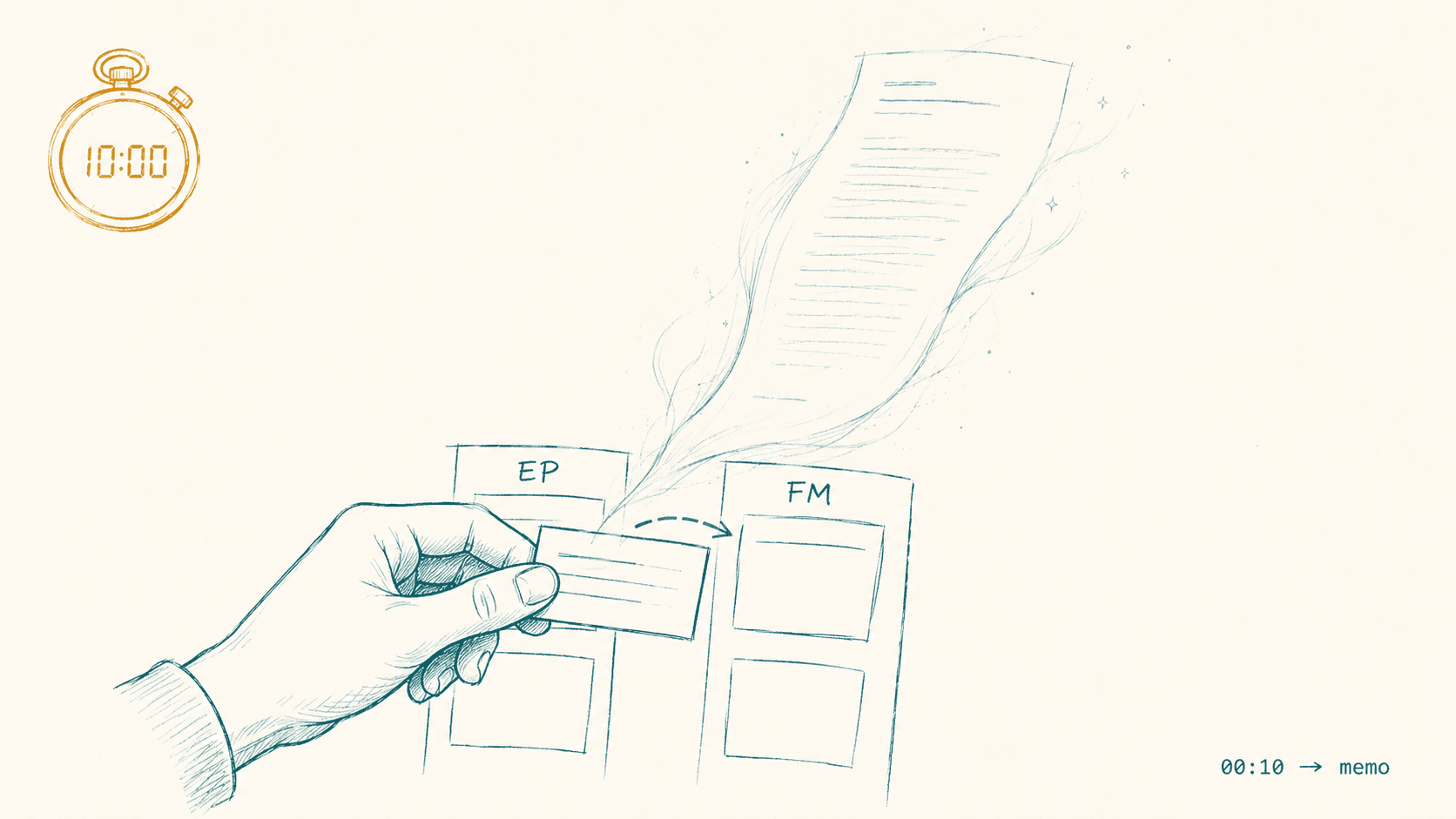
A hand sliding a kanban card between deal stages in ClickUp — a translucent memo materializing above it, a ten-minute stopwatch counting in the corner.
01

ClickUp stage-change trigger with a ten-minute delay

The trigger lives where the analyst already works — moving a deal-card between stages. When a card moves, a webhook fires, the system waits ten minutes (room for the analyst to undo or add context), and only then runs the memo generation. The trigger is the analyst's existing motion, not a new button.

02

Time-windowed evidence per stage

Startups don't move forward linearly. They go EP → FM → back to EP → FM again. We track every conversation by which stage occupancy it falls under. The IC memo for a startup in FM is generated only from conversations that happened during the most recent FM occupancy. Smearing evidence across stages was the version of the bug that nearly broke the product.

03

Pluggable notetaker adapter pattern

Each notetaker (Fireflies, Read.ai, Fathom, Granola) has its own adapter under `server/src/services/`. Adding a new notetaker is a new adapter, not a code surgery. When Granola moved from MCP to a personal API key one Monday morning, we rewrote the adapter in 36 hours without touching the rest of the system.

04

Toggles for what the AI can see

Layer two of the trigger journey: a UI surface where the analyst can toggle which Google Chat spaces the AI is allowed to read for context. The act of explicit consent — moving a decision from us to her — tripled the memos she touched. Toggle as automation primitive.

05

Forty-two diligence questions per memo

Each IC memo follows a fixed structure of forty-two diligence questions grouped by category. The Claude call returns a typed JSON object that maps cleanly to ClickUp doc sections. The structure ensures the memo defends the same things every time, in the same order, with the same evidence anchors.

06

Delayed queue with retries

After we discovered the synchronous handler had failed for 104 consecutive deliveries (ClickUp's webhook timeout is 30 seconds; our pipeline was sometimes slower), we moved everything to a delayed queue with retries. The ten-minute delay turned out to be a feature, not a workaround — it gives the analyst time to undo a misclick. The bug picked the design.

04 — Architecture

In plain English, why each choice.

Frontend
Next.js 16 + React 19 with the App Router. The fund's analyst-facing surfaces (toggle settings, memo history, manual re-run) live here. shadcn/ui as the primitive layer; minimal Framer Motion for the kinds of micro-interactions that signal a tool, not a website.
Backend
Hono backend in a Turborepo monorepo, deployed to Vercel separately from the frontend. OpenAPI-TS for end-to-end type-safe API contracts; the frontend has zero hand-written client code. Webhook handlers, queue workers, notetaker adapters, ClickUp client all organized by domain under `server/src/services/`.
Notetaker integration layer
Each notetaker is wrapped in an adapter that exposes the same internal shape — get_calls(since), get_transcript(call_id), get_speakers(call_id). The pluggable shape was the part of the architecture that made the Granola MCP-to-API-key migration manageable.
AI orchestration
Anthropic Claude Sonnet 4.6 with a 400-token system prompt that has gotten shorter over time, not longer. The current production prompt is roughly a third the length of what we shipped in week one and produces strictly better memos. The 42-question structure is enforced by a Zod schema; structured-output JSON ensures the memo can be parsed into ClickUp doc sections without LLM-formatting drift.
ClickUp integration
Deal-stage-change webhook subscription on the relevant ClickUp Space. The webhook handler validates, enqueues a delayed job, and returns 200 within ClickUp's 30-second window. The job worker pulls the transcript window, calls Claude, and posts the memo back as a structured doc update plus a four-question summary as a comment on the card.
Auth + multi-tenancy
Supabase SSR with cookie-based JWT auth. The deployment is currently single-tenant (one fund) but architected for multi-tenant — every entity is scoped by `org_id`, every endpoint enforces that scope server-side. Adding a second fund is a configuration exercise, not a refactor.
05 — Outcomes

What changed after launch.

Near 100%
AdoptionOnce the trigger moved to deal-stage-change.
0 → most-of-portfolio
Memos auto-generatedWithin a week of the trigger rebuild.
10-min
Configurable delayBuilt room for the analyst to change her mind.
Stage-windowed
Evidence accuracyEach memo cites only conversations from the relevant stage occupancy.

MethodologyAdoption observed by the analyst and the fund's internal review of the IC memo workflow. 'Near 100%' is measured against the count of cards moved through diligence stages in a given week. The engineering story is the trigger; the underlying conversion of insight to outcome is documented in our published essay on the build.

The memos became defensible the moment the system was responding to my actual work — not running on a schedule somewhere I couldn't see.

Investment AnalystIndia-based venture fund
06 — What’s next

A multi-fund deployment with shared notetaker integrations and per-fund prompt configuration. A retrieval layer over the fund's historical memos so the AI can cite the fund's own prior language and judgments. And a deeper closing-the-loop mode where the system surfaces, at memo generation time, the diligence questions that previously distinguished portfolio winners from losers.

Stack
  • Next.js 16
  • React 19
  • Hono
  • Turborepo
  • Vercel
  • Anthropic Claude
  • Zod
  • Supabase SSR
  • OpenAPI-TS
  • ClickUp API
  • Fireflies API
  • Read.ai API
  • Fathom API
  • Granola API

Building an AI workflow tool? Start with the trigger.

Quorum is portable as a pattern. Sales tools, recruiting pipelines, status reports, customer-success automations — anything that turns conversations into structured work shares the same question: where does the trigger live. We can scope a Quorum-shaped automation for your team in 4–8 weeks.

Start a conversation